Process Stability and Data Sovereignty Through Integrated Data Analysis
Vibration Monitoring on Roll Grinding Machines
Roll grinding machines are among the key production systems in the steel, aluminum, and paper industries. They ensure that rolls of various types, such as work rolls and backup rolls, achieve the required geometry and surface quality, thereby providing the foundation for stable downstream production processes. Deviations in roll geometry or surface characteristics can have a direct impact on subsequent production stages and ultimately affect product quality.
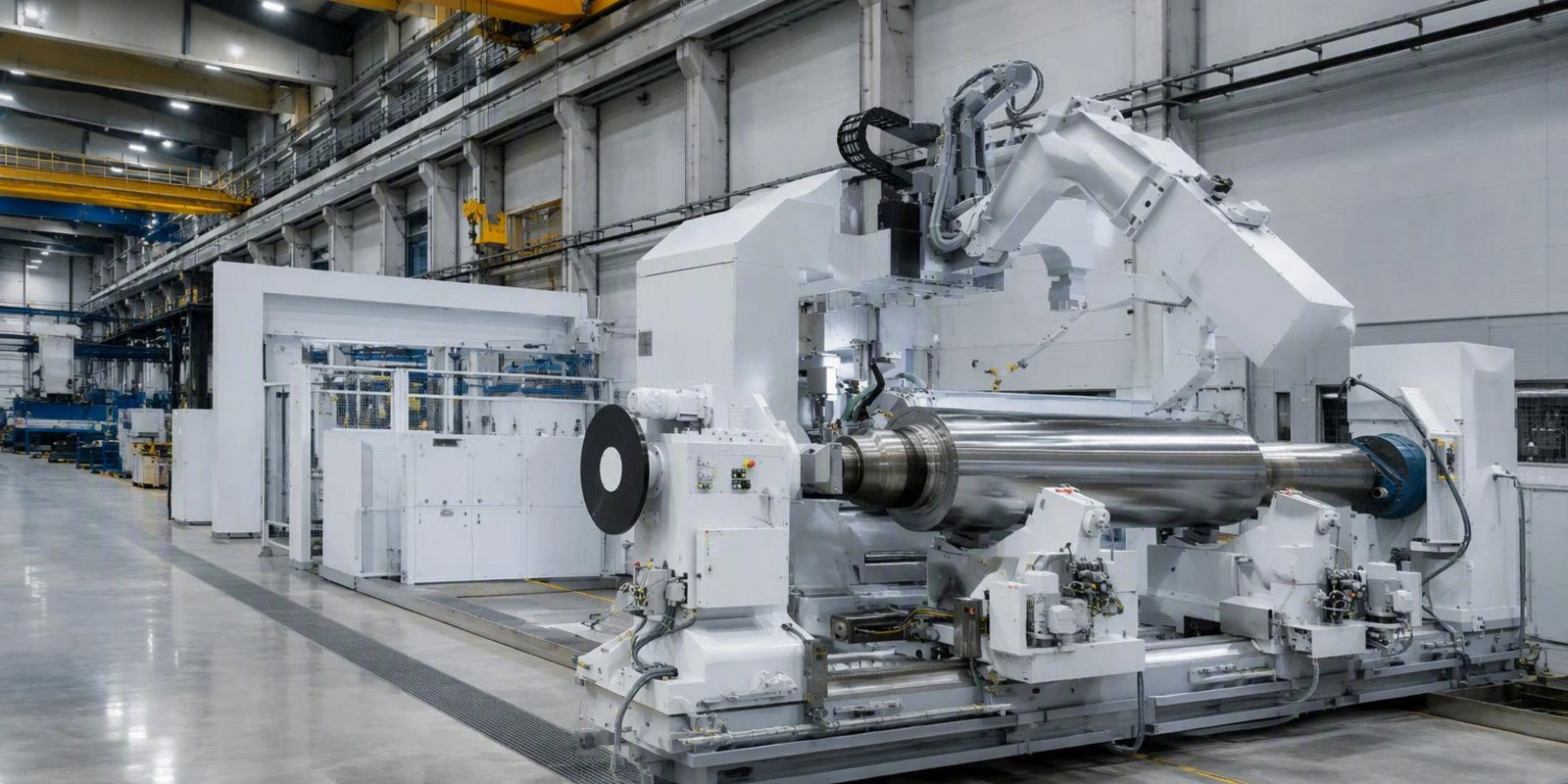
As quality requirements and demands for process reproducibility continue to increase, so does the need for comprehensive monitoring of the grinding process. Different roll types, varying machining tasks, and increasingly tight tolerances require precise process supervision. At the same time, manufacturers are placing greater emphasis on the long-term storage, analysis, and utilization of grinding machine data to support continuous process improvement initiatives.
Although modern grinding machines incorporate sophisticated control and diagnostic systems, the generated process data is often only partially accessible for advanced analytics.
As a result, open and vendor-independent data architectures are becoming increasingly important for companies seeking to archive data long term, perform their own analyses, or implement condition monitoring strategies.
Why Vibrations Are a Key Quality Indicator
The fundamental design of roll grinding machines is largely comparable across manufacturers. The roll is clamped and driven between the headstock and tailstock. Depending on workpiece dimensions, steady rests provide additional support, while the grinding carriage performs the actual machining process.
During grinding, various dynamic loads are generated. Rotating components, bearing systems, drive assemblies, and the interaction between the grinding wheel and the workpiece all influence the machine's vibration behavior. Even minor changes in vibration characteristics can affect surface finish, machining quality, and overall process stability.
Consequently, vibration signals provide a highly valuable source of information. They not only reveal the condition of mechanical components but also provide insight into the grinding process itself. When changes are detected early, quality issues can be prevented and process parameters can be adjusted proactively.
Combining Process and Vibration Data for Deeper Insight
For meaningful analysis, isolated measurement values are often insufficient. A reliable assessment of the grinding process requires the precise temporal correlation of machine states, process parameters, and vibration signals.
Open data acquisition and analysis solutions such as the iba system provide the necessary foundation. Using ibaPDA, process and machine data can be continuously acquired directly from the machine control system and recorded synchronously. All relevant information is stored on a common time base, creating a consistent dataset for further analysis.
In addition, vibration sensors installed on critical machine components capture high-dynamic signals that are acquired through the iba modular system and made available within ibaPDA. This approach enables seamless integration of vibration monitoring into the existing data acquisition infrastructure.
By consolidating all information within a single platform, process events can be accurately correlated with the machine's actual vibration behavior. As a result, root causes of abnormalities can be identified significantly faster than with isolated measurement systems.
Efficient Engineering Through Reusable Signal Structures
Beyond data acquisition, engineering efficiency plays a crucial role in the implementation of monitoring solutions. Standardized machine concepts often involve highly similar signal structures that can be reused across multiple projects. With ibaPDA, signals can be organized and processed independently of specific controller addresses. Existing project structures can therefore be transferred easily to comparable machines and installations.
"Whenever similar projects are expected to be implemented repeatedly, the Signal Mapper function in ibaPDA should be utilized from the very beginning," explains Eugen Graz. “The benefits of project reusability become evident within a very short time.”
When applied across multiple similar machines, this approach significantly reduces engineering effort while ensuring a consistent and comparable data structure throughout the plant.
Vibration data only unlocks its full value when it is analyzed in the context of machine and process data. The iba system provides a unified platform that enables this correlation, helping users identify root causes faster, improve process stability, and build effective condition monitoring strategies.
Eugen Graz
Application & Consulting Engineer, iba AG
Vibration Analysis Directly Within the Running Process
The true strength of an integrated solution lies in the continuous analysis of vibration signals during ongoing operation. Raw data is first conditioned and reduced to appropriate data rates depending on the specific analysis task.
Using ibaInSpectra, which is integrated directly into the data acquisition environment, vibration indicators and frequency analyses can be calculated in real time. In addition to standard FFT evaluations, application-specific key performance indicators (KPIs) can be configured to address the unique requirements of roll grinding processes.
By simultaneously evaluating acceleration and velocity signals, different frequency ranges can be examined. This enables a differentiated assessment of a wide variety of vibration sources, ranging from mechanical irregularities to process-induced effects.
Particularly important is the consideration of the current operating point and the type of roll being processed. Not every operating phase of a grinding machine is equally suitable for vibration evaluation. Therefore, analyses in ibaInSpectra can be linked specifically to defined machining steps. KPI calculations are activated only when the grinding process reaches a predefined operating condition and are then evaluated against individualized threshold values for the respective roll type.
This approach increases the relevance of analytical results while significantly reducing the likelihood of false alarms.
Transparent Visualization for Operations and Process Analysis
To create value in daily production environments, analytical insights must be presented in an intuitive and accessible manner. With ibaQPanel, key process, machine, and vibration data can be visualized within a unified interface.
A particularly effective visualization tool is the sonogram, which illustrates the temporal development of frequency components over extended periods. Complementary displays may include live FFT spectra, process values, and critical operational parameters such as grinding wheel speed and roll rotational speed.
The combined visualization of all relevant information simplifies the interpretation of complex relationships. Changes in vibration behavior can be directly linked to specific process conditions, enabling operators to assess the current machine state while supporting process engineers in root cause investigations.
Additional status indicators further facilitate the rapid identification and evaluation of critical operating conditions.
Unlocking Long-Term Value from Data
The benefits of vibration monitoring extend far beyond real-time condition assessment. Many optimization opportunities emerge only through the long-term analysis of historical data. With ibaHD-Server, process and analysis data can be stored centrally and archived over extended periods. This creates a comprehensive data history that supports benchmarking, trend analysis, and in-depth investigations.
Historical grinding profiles of identical roll types can be compared across production campaigns or over long time horizons. Process owners gain valuable insight into quality deviations, threshold optimization, and recurring behavioral patterns.
At the same time, centralized data storage forms the foundation for advanced applications such as measurement reports, quality reporting systems, and data-driven optimization projects.
Data Sovereignty as a Critical Success Factor
Beyond the technical advantages, data sovereignty has become a decisive factor for many plant operators. Open data acquisition and analysis platforms provide unrestricted access to process and vibration data, independent of individual machine vendors or proprietary systems.
Engineers can create their own evaluations, develop custom analytical models, and investigate new process-related questions without being limited to predefined reports or closed software environments. This freedom enables a substantially deeper understanding of both production processes and their influencing factors.
The combination of centralized data acquisition, real-time analytics, and long-term data historization creates the foundation for continuous improvements in product quality, process stability, and equipment availability.
Vibration monitoring on roll grinding machines is increasingly evolving from a traditional condition monitoring application into a strategic tool for process understanding and quality optimization. The key is not the isolated evaluation of individual measurements but the integrated analysis of machine data, process information, and vibration signals.
The iba system provides a comprehensive platform for implementing these requirements. By combining synchronized data acquisition, real-time vibration analytics, intuitive visualization, and long-term data storage, operators gain detailed insight into machine performance while establishing the foundation for sustainable process optimization, data sovereignty, and data-driven condition monitoring strategies.
Integrated and automated vibration analysis has therefore become an essential component of modern roll grinding applications, where transparency, traceability, and process stability are critical success factors.
Funciones usadas
En esta aplicación se utilizan las siguientes funciones del sistema iba.
