IEC 61850 Substation Monitoring
The IEC 61850 standard defines the communication architecture used in modern substations by distinguishing between two communication layers: the…
Learn more
Electrical disturbances develop within milliseconds—or even microseconds. To protect critical assets and minimize downtime, these events must be captured with maximum precision. The iba system continuously monitors electrical and process signals at high sampling rates.
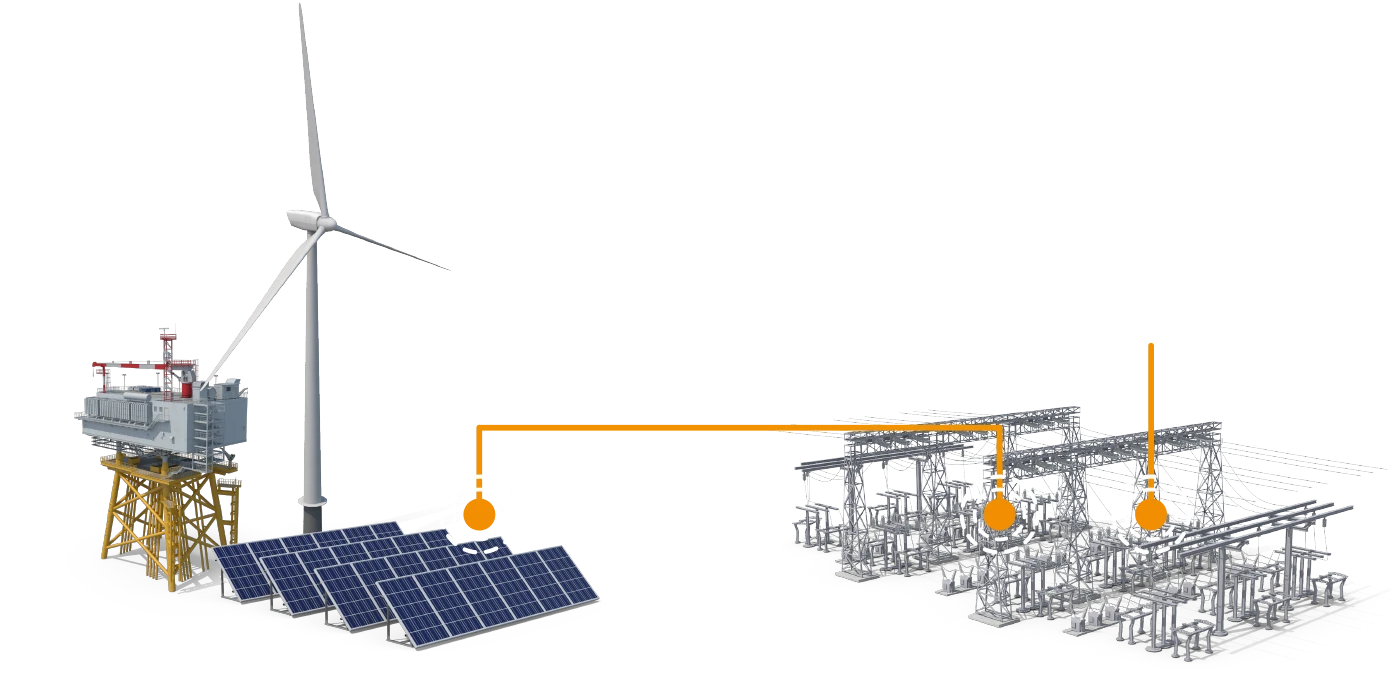

Whenever a predefined trigger condition is met, the system automatically records all relevant data with high temporal resolution, providing the information required for detailed fault analysis.
Discover how the iba system supports operational excellence and enables visibility for the grids of tomorrow. Schedule a one-on-one call now.
Book Your 1:1 Call
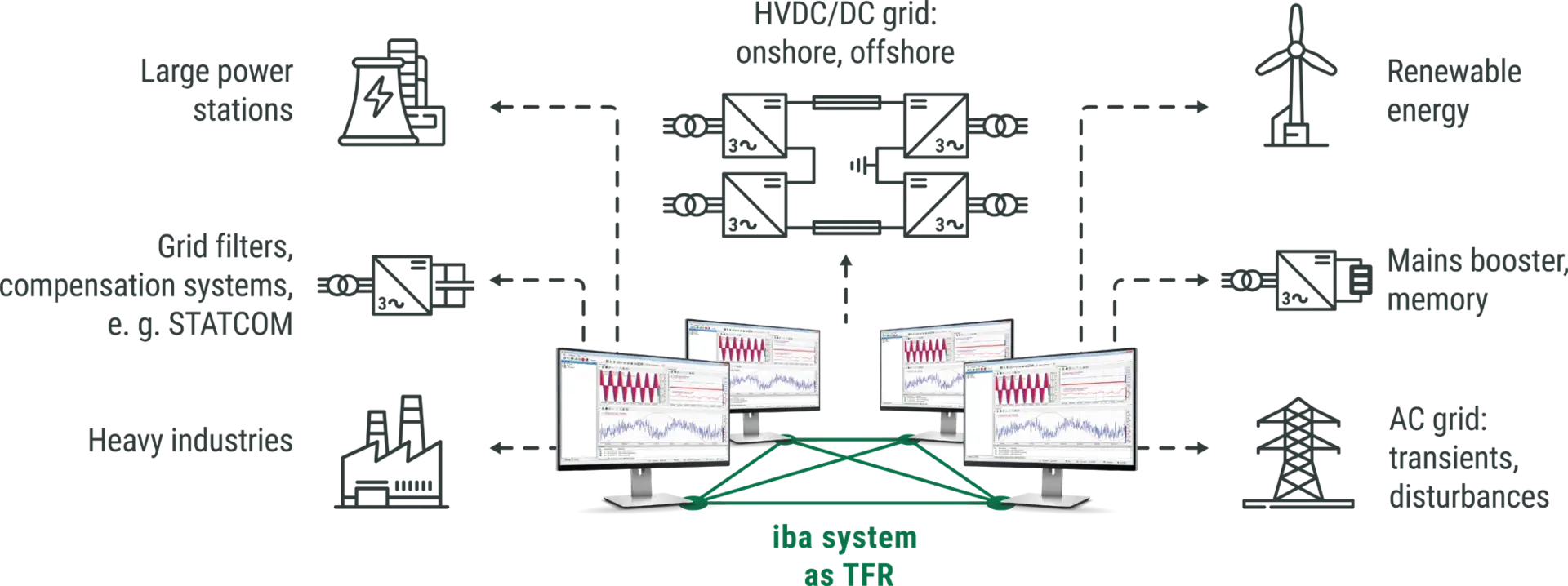
As a high-performance Transient Fault Recorder (TFR), the iba system continuously supervises plant operation and detects anomalies across thousands of signals.
Once a fault is detected, trigger-controlled recording begins immediately, capturing both the events leading up to the fault and the system response afterwards. This comprehensive recording enables engineers to identify root causes with confidence.
Effective fault analysis requires more than isolated measurements. The iba system combines analog measurements, digital control signals, process information, IEC 61850 communication, and power quality data into one synchronized recording. Viewing all relevant information on a common time axis provides a complete understanding of system behavior during critical events.
Every incoming signal can serve as a trigger—not only analog measurements but also controller data, substation events, process monitoring information, and power quality alarms. Suitable high-speed acquisition hardware allows dynamic processes to be recorded with resolutions ranging from milliseconds down to microseconds.
The iba system can continuously monitor more than 10,000 signals per station. Trigger conditions are configured individually using an intuitive editor that supports analog signals, digital signals, and complex logical combinations.
Different sampling rates can be assigned according to application requirements, with the ibaMAQS platform supporting acquisition rates of up to 500 kHz.
In addition to analog and digital process signals, IEC 61850 event messages—including GOOSE communication—can also initiate recordings. When the ibaPQU-S Power Quality Unit is integrated into the system, power quality events may likewise be used as trigger conditions. For complex monitoring applications, triggers can be grouped into configurable Trigger Pools, allowing multiple signals to initiate or terminate recordings according to predefined logic.
Large installations often require several ibaPDA systems operating simultaneously. In multistation mode, up to five ibaPDA systems function as one synchronized acquisition platform. All systems sample data with sub-sample synchronization accuracy.
When one measuring station detects a trigger event, every connected measuring station starts recording simultaneously, ensuring consistent event documentation across the entire installation.
HVDC installations frequently span hundreds or even thousands of kilometers. Despite these distances, all measurements must remain perfectly aligned in time. The iba Multistation architecture distributes trigger information together with precise timestamps. Even if communication latency exists between remote stations, all recordings begin at the identical absolute time, ensuring complete synchronization throughout the network.
During post-processing, all recorded datasets can be opened simultaneously in ibaAnalyzer. Because every recording shares the same timestamps and sample alignment, engineers can analyze distributed systems as though every signal had been acquired by one centralized measurement platform.
The example shown illustrates current and voltage trends on both the AC and DC sides during a shutdown and subsequent restart of an HVDC installation. High-resolution recordings reveal the exact sequence of events before, during, and after the disturbance. Alongside electrical measurements, several thousand controller signals are recorded and synchronized with microsecond accuracy. This comprehensive dataset provides plant operators, commissioning engineers, and system developers with detailed insight into plant behavior, enabling faster troubleshooting and continuous system optimization.

Download the demo of ibaPDA and ibaAnalyzer and start optimizing your processes today. Try it free of charge for 30 days!
Request an ibaPDA-Demo LicenseThe following functions of the iba system are used in this application.
These leading companies already rely on the iba system.


Successful applications and real solutions with the iba system.
The IEC 61850 standard defines the communication architecture used in modern substations by distinguishing between two communication layers: the…
Learn moreThe system calculates all power quality parameters specified in EN 50160 using the measurement procedures defined by IEC 61000-4-30 Class A, ensuring…
Learn more
The iba system provides a comprehensive solution for evaluating and improving energy efficiency by combining energy and process data within a single…
Learn more
The iba system provides complete visibility into industrial processes and electrical power infrastructures. All hardware and software components are…
Learn more