Event Monitoring: Transient Fault Recorder
Electrical disturbances develop within milliseconds—or even microseconds. To protect critical assets and minimize downtime, these events must be…
Learn more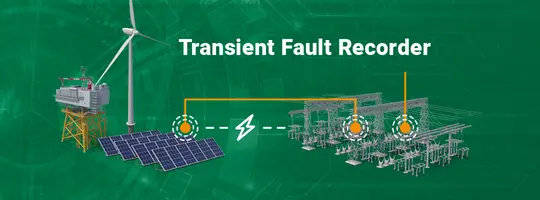
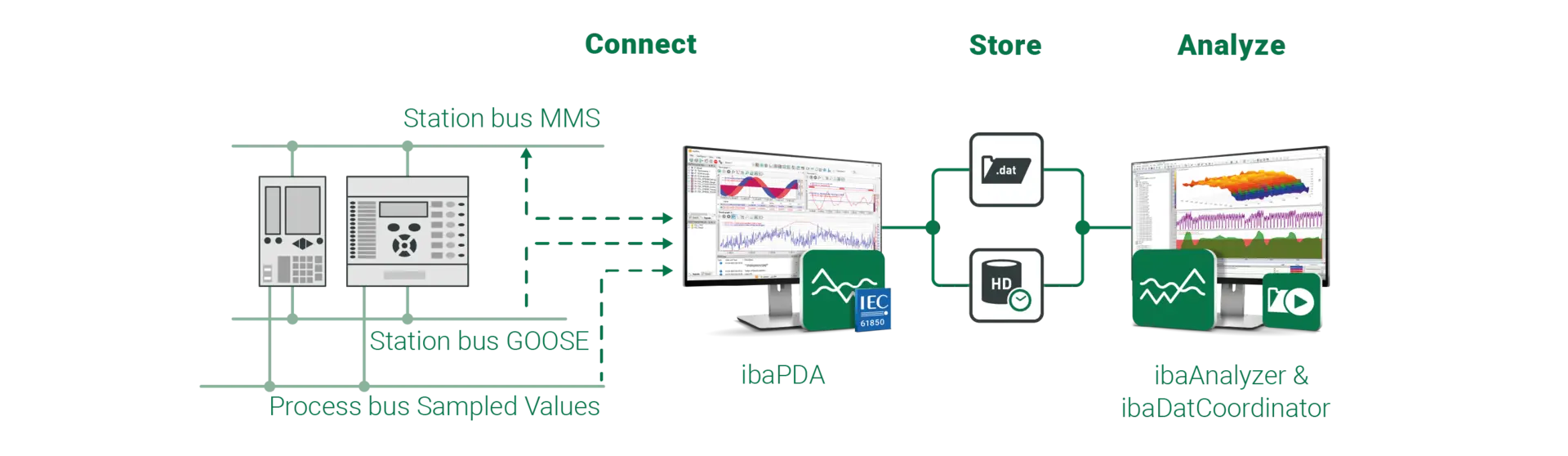
The IEC 61850 standard defines the communication architecture used in modern substations by distinguishing between two communication layers: the station bus and the process bus. With its native IEC 61850 interface, the iba system captures both communication layers within a single platform.

The station bus manages the exchange of status information between intelligent electronic devices (IEDs) and supervisory control systems, while the process bus is designed for deterministic real time communication of protection events, measured values, and automation signals. Status information is acquired through MMS communication, while high-speed process data is recorded via GOOSE messaging and Sampled Values (SV).
Discover how the iba system supports operational excellence and enables visibility for the grids of tomorrow. Schedule a one-on-one call now.
Book Your 1:1 Call
MMS follows a client-server architecture that allows protection relays and other intelligent devices to exchange operating data, measured values, parameters, and status information with higher-level control systems.
Using the reporting functionality defined by IEC 61850, ibaPDA acts as an active MMS client and subscribes to predefined datasets. Whenever a value changes, the device automatically reports the update without requiring cyclic polling, significantly reducing communication overhead while improving system performance.
GOOSE communication enables deterministic, real time exchange of protection and automation events between IEC 61850 devices. Operating as a subscriber within the network, ibaPDA continuously monitors GOOSE traffic, extracts relevant signals together with their associated timestamps, and records them for subsequent fault analysis. This makes it possible to reconstruct system events with exceptional temporal accuracy.
Sampled Values (SV) provide digitized current and voltage measurements at sampling rates ranging from 4 kHz to 100 kHz, replacing conventional analog signal transmission. As an additional subscriber, ibaPDA records these high-speed measurement streams alongside process events, allowing measured values and fault events to be analyzed within one synchronized dataset.
Accurate fault analysis requires more than simply recording events—it requires preserving their original timing. The iba system records all IEC 61850 events together with the timestamps generated by the source devices. This allows engineers to reconstruct the exact sequence of events and evaluate system behavior with maximum precision.
Questions such as which protection relay responded first, whether protection coordination was successful, or how the overall system reacted can be answered reliably, independent of network communication delays.
By integrating IEC 61850 communication with iba Process Monitoring, users gain complete visibility into the interaction between electrical infrastructure and industrial processes. Grid events can be analyzed alongside production activities, while operational changes—such as switching large electrical loads—can be directly correlated with network behavior.
During configuration, ibaPDA automatically imports the IEC 61850 data model from connected IEDs or from SCL engineering files. Based on this information, structured address books are generated, including the available Logical Devices, Logical Nodes, Data Objects, and Data Attributes. These address books simplify signal selection, minimize engineering effort, and ensure consistent mapping of IEC 61850 data throughout the project.
Even without live communication, the complete IEC 61850 information model can be imported directly from SCL engineering files, such as SCD or CID files. This enables offline engineering, simplifies commissioning, and supports monitoring applications where read-only access to the station or process bus is required.
Protection relays store fault recordings in COMTRADE format. Whenever a new COMTRADE file is created, ibaPDA automatically detects the recording and transfers it to a predefined destination directory. Using ibaDatCoordinator and ibaAnalyzer, these recordings can subsequently be converted into iba-DAT or other supported formats. Additional metadata—including device names and timestamps—can automatically be appended to file names, ensuring clear traceability even in installations containing numerous protection devices.
Rather than analyzing individual relay recordings separately, the iba system consolidates all relevant information into one synchronized dataset, providing a complete overview of system-wide events and significantly accelerating fault analysis.
The following functions of the iba system are used in this application.
These leading companies already rely on the iba system.


Download the demo of ibaPDA and ibaAnalyzer and start optimizing your processes today. Try it free of charge for 30 days!
Request an ibaPDA-Demo LicenseSuccessful applications and real solutions with the iba system.
Electrical disturbances develop within milliseconds—or even microseconds. To protect critical assets and minimize downtime, these events must be…
Learn moreThe system calculates all power quality parameters specified in EN 50160 using the measurement procedures defined by IEC 61000-4-30 Class A, ensuring…
Learn more
The iba system provides a comprehensive solution for evaluating and improving energy efficiency by combining energy and process data within a single…
Learn more
The iba system provides complete visibility into industrial processes and electrical power infrastructures. All hardware and software components are…
Learn more