Power and Process Monitoring
The iba system tells you exactly what is happening in your plants and your energy system. The components are all perfectly coordinated with one…
Learn more
In many industrial and mobile applications, distributed control architectures rely on fieldbus systems that enable robust, deterministic communication between controllers, sensors, and actuators. Here, the Controller Area Network (CAN) has been a proven communication technology.
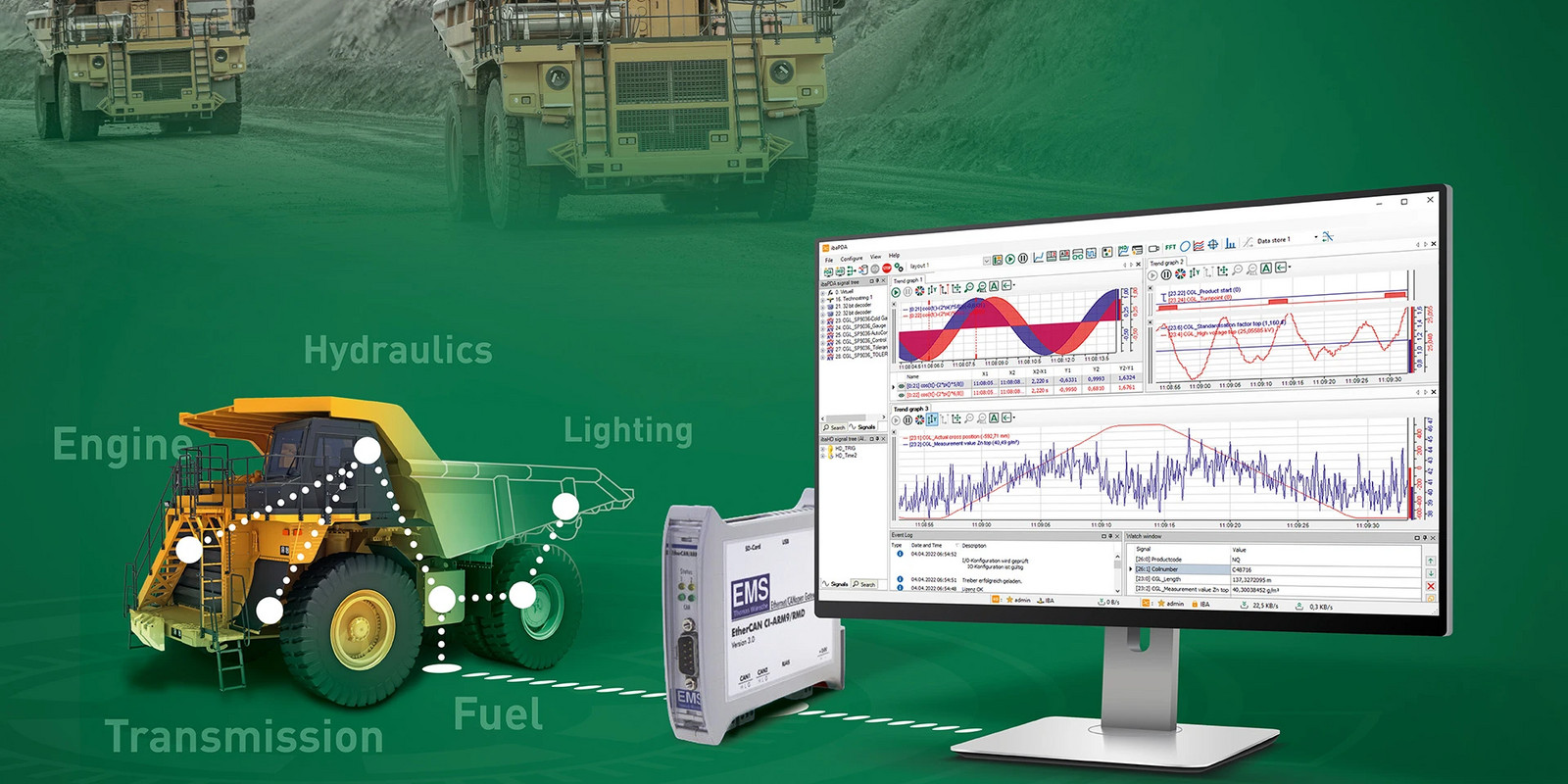
Originally developed for automotive applications, CAN-based communication is now widely used in machines, mobile equipment, and decentralized systems where robustness, determinism, and real-time capability are essential. In many industrial installations, CAN-based subsystems operate alongside PLC-controlled automation systems, drives, and higher-level monitoring solutions. While CAN is widely used for real-time communication between devices, accessing and analyzing CAN data in a broader process context remains a technical challenge.
Modern industrial diagnostics and optimization require more than basic monitoring or event-based logging. Engineers need continuous access to raw communication data, precise time synchronization with other process signals, and the ability to analyze system behavior retrospectively. CAN-based measurement systems therefore play an very important role in gaining transparency across heterogeneous automation environments.
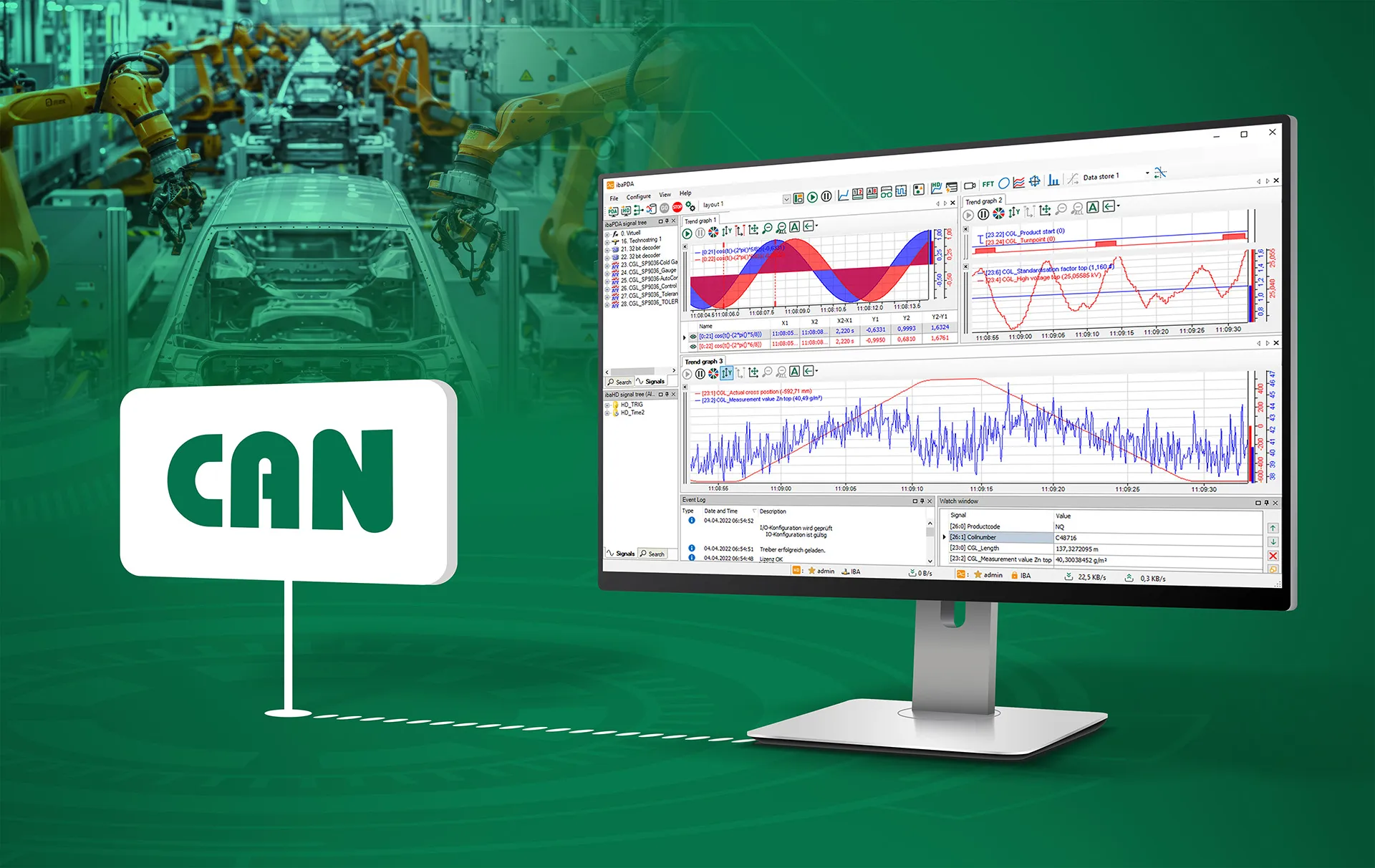
At its core, CAN defines a message-oriented communication mechanism that allows devices to exchange data efficiently and reliably. From a measurement perspective, CAN frames themselves represent valuable signals: message identifiers, payload data, timing, and transmission behavior provide insights into the state and interaction of connected devices.
In many installations, CAN communication is monitored only indirectly, for example through device diagnostics or controller status information. Such approaches often fail to capture short communication disturbances, timing irregularities, or correlations between CAN traffic and physical process behavior. A measurement-oriented approach treats CAN messages as time-stamped signals that can be recorded continuously and evaluated in relation to other process data.
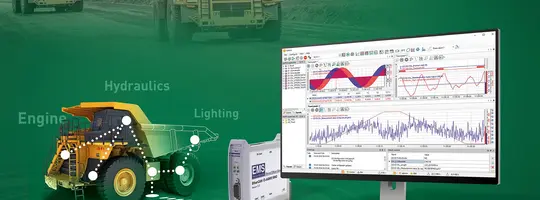
With the CAN integration introduced in ibaPDA v8.12.0, the iba system enables direct acquisition of CAN bus communication via Ethernet. Using the EtherCAN CI-ARM9/RMD-IBA gateway from EMS Thomas Wünsche, CAN messages can be read from the bus and transferred to ibaPDA without interfering with the active communication. This passive approach ensures that existing CAN networks remain unaffected while making all transmitted CAN data available for data acquisition, online visualization and analysis.
Within ibaPDA, CAN messages are handled in the same way as other process data. The values in the messages are timestamped, visualized, recorded continuously, and synchronized with other signals acquired from PLCs, drives, sensors, and measurement hardware. This unified time base is essential for understanding how CAN communication relates to machine states, control sequences, and physical process variables.
A key advantage of CAN-based measurement with the iba system is the ability to record communication data continuously, without relying on triggers or predefined fault conditions. Many relevant events on the CAN bus occur sporadically or only under specific operating conditions. By capturing all communication data, ibaPDA ensures that even brief anomalies remain available for later investigation.
The recorded data can be stored locally in measurement files and, if required, archived in ibaHD-Server for long-term retention. This creates a comprehensive history of CAN communication and associated process data, enabling detailed root cause analysis, comparison of operating states, and long-term system evaluation.
For technical analysis, the recorded CAN data is evaluated using ibaAnalyzer. CAN messages can be visualized alongside PLC variables, analog measurements, and digital signals in a common time domain. This makes it possible to correlate communication behavior with mechanical movements, electrical loads, or control actions.
Derived signals and expressions can be used to interpret raw CAN payload data or to calculate timing-related indicators such as message intervals or response delays. Instead of analyzing CAN traffic in isolation, engineers gain a system-level view that supports structured troubleshooting and performance assessment.
The report generator integrated in ibaAnalyzer allows the creation of standardized analysis reports based on recorded data. These reports can document communication behavior, event sequences, or trends over defined periods and support transparent communication between engineering, maintenance, and commissioning teams.
CAN-based measurement systems integrated into the iba architecture are particularly valuable in applications where CAN-controlled subsystems interact with complex automation environments. Typical examples include mobile machinery, test benches, energy systems, and production equipment with decentralized components.
From a technical standpoint, the main benefit lies in the consistent and synchronized acquisition of CAN communication together with process and automation data. This approach reduces diagnostic effort, shortens troubleshooting cycles, and improves system understanding. By making CAN communication fully traceable and analyzable in context, the iba system supports more reliable operation and data-driven optimization of industrial systems.
CAN communication remains a critical element in many industrial and mobile applications. However, its diagnostic value can only be fully exploited when communication data is captured continuously and analyzed in relation to the overall system behavior. By integrating CAN bus measurement into ibaPDA via an Ethernet-based gateway, the iba system provides a technically sound solution for acquiring, storing, and analyzing CAN data together with other process signals for a holistic view of the process behavior.
Combined with powerful analysis tools and long-term data storage, this approach enables deeper insight into communication behavior, faster fault identification, and improved transparency in complex automation environments — without interfering with existing CAN networks.
These leading companies already rely on the iba system.


Successful applications and real solutions with the iba system.
ibaPDA enables synchronized acquisition of CAN messages alongside PLC variables, sensor data, and other process signals on a common time base. This allows engineers to directly correlate communication events with machine behavior and production processes. The synchronized approach improves root cause analysis, increases transparency across distributed automation systems, and provides a reliable foundation for optimization, commissioning, and predictive maintenance.
With ibaPDA, CAN communication is recorded continuously instead of relying solely on event-based logging. Even short-lived communication irregularities and intermittent faults remain available for later investigation. Combined with ibaHD-Server, the solution provides long-term historical data that supports comparisons between operating conditions, accelerates troubleshooting, and enables data-driven maintenance and process optimization.
ibaPDA provides direct CAN data acquisition via an Ethernet-based gateway, allowing existing CAN networks to be monitored passively without affecting normal communication. CAN messages are handled like any other process signal, making it easy to combine them with PLC data, drive information, and other automation signals. This creates a unified data source for monitoring and analysis without requiring modifications to the control application.
Using ibaAnalyzer, engineers can evaluate CAN messages alongside analog measurements, digital signals, and PLC variables on a shared timeline. Built-in calculation functions also allow communication metrics such as message intervals and response times to be derived automatically. This integrated analysis reveals relationships between communication behavior and physical machine processes, enabling faster troubleshooting and more effective performance optimization.
CAN-based measurement systems provide the transparency needed to evaluate communication data in the context of the entire production process. ibaPDA, ibaAnalyzer, and ibaHD-Server form an integrated platform for acquiring, archiving, and analyzing both CAN and process data. This enables operators to detect communication issues earlier, assess system performance over time, and optimize complex automation environments without interfering with existing CAN networks.