Power and Process Monitoring
The iba system provides complete visibility into industrial processes and electrical power infrastructures. All hardware and software components are…
Learn more
Many industrial processes follow recurring patterns, whether in batch-oriented production or cyclic manufacturing operations. Within these repetitions lies significant continuous improvement potential. The iba system leverages this by enabling the comparison of measurements recorded under comparable operating conditions. Through synchronized snapshots and long-term trending with high-resolution time-series data, users can establish reference conditions and compare different production runs.

A key advantage in this context is the ability to replay historical process situations and overlay datasets from different batches, products, or machine cycles on a common time axis. This allows engineers to compare current production directly against a known reference state and identify even subtle deviations in process behaviour. Variations in vibration behaviour, temperature profiles, process dynamics, or machine loads become immediately visible when datasets are aligned and analyzed synchronously.
This capability is particularly valuable for identifying gradual process drifts or quality-relevant changes that would remain hidden in isolated KPI evaluations or trapped in data silos. By comparing multiple production runs, operators can detect how process behaviour evolves over time and determine under which operating conditions optimal product quality was achieved. This approach supports strategies such as golden batch comparison, where the objective is to continuously align production with a proven optimal reference state and detect deviations at an early stage to protect asset health.
Beyond analysis, the iba system enables the automated generation of dashboards, KPI reports, alarms, and long-term performance evaluations. Modern web-based visualizations in ibaDaVIS provide operators and engineers with a transparent overview of plant conditions and production performance in real time. Relevant process, condition, and energy data can be consolidated into centralized dashboards that visualize operational states across entire production lines or sites.
In addition to process-specific KPIs, the system also supports the calculation and visualization of higher-level performance indicators such as Overall Equipment Effectiveness (OEE), availability, quality rates, cycle times, or energy-related metrics. These indicators can be combined with high-resolution process and condition data to establish a direct connection between machine behaviour and production performance.
Reports can be generated automatically at configurable intervals and distributed as PDF documents or digital reports to relevant stakeholders. This replaces manual spreadsheet-based evaluations with automated and standardized reporting workflows. By combining synchronized process data with automated KPI generation, companies gain a significantly higher level of operational transparency and establish a consistent foundation for data-driven decision-making.
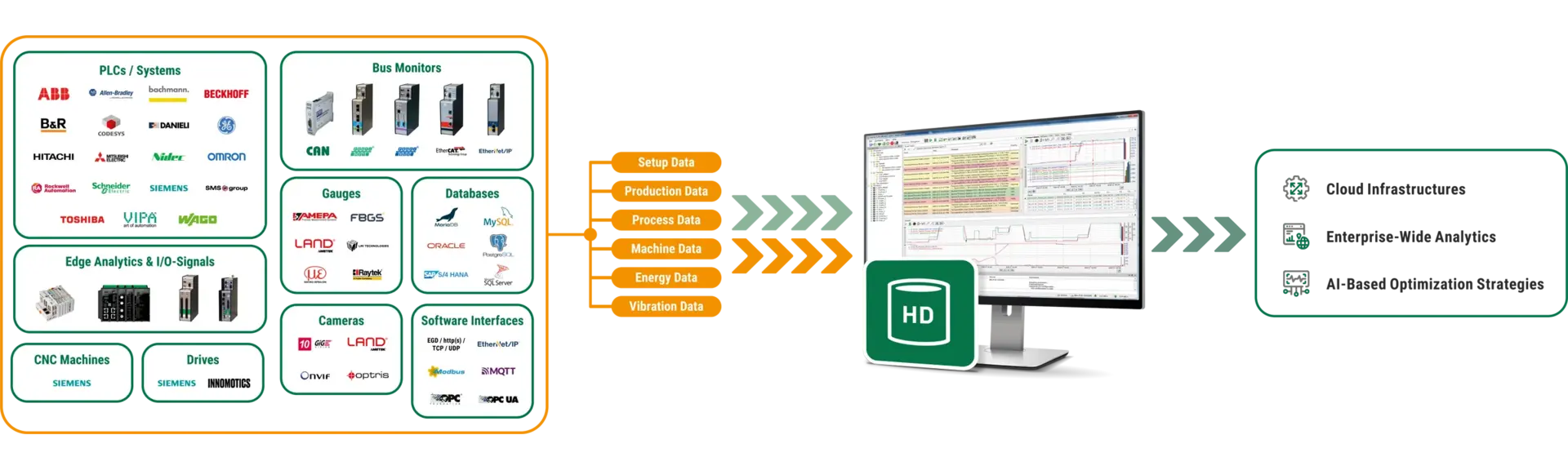
Modern industrial architectures require seamless integration between operational technology and higher-level IT environments. ibaHD-Server not only serves as a central historian but also acts as a structured and reliable data foundation for enterprise-wide applications, cloud platforms, and advanced analytical environments.
By providing synchronized, high-resolution time-series data, the iba system enables the integration of machine learning models and AI-driven analytics into industrial workflows. Historical and live process data can be shared to cloud-based platforms, data lakes, or external analytics systems, where machine learning algorithms can identify hidden correlations, detect anomalies, or predict future process behaviour.
This creates new possibilities for predictive maintenance, automated quality prediction, and process optimization. AI models can be trained using synchronized vibration, process, energy, and condition data to recognize patterns that would be difficult to detect manually. At the same time, the historian remains the reliable operational backbone that preserves the original time-synchronous data context required for trustworthy AI analysis.
Within modern digital architectures, ibaHD-Server is increasingly evolving into more than just a historian. It is becoming a central OT intelligence layer that connects machine-level data acquisition with enterprise-wide analytics, cloud infrastructures, and AI-based optimization strategies.

The real value of industrial data lies in understanding why something happened, not just knowing that it happened. ibaHD-Server provides the context needed for faster root cause analysis and better decisions.
Thomas George
Product Manager, iba AG
The following functions of the iba system are used in this application.
Successful applications and real solutions with the iba system.
ibaHD-Server helps manufacturers identify the root causes of process deviations by enabling direct comparisons between historical and current production data. Engineers can replay previous operating situations and align datasets from different batches, products, or machine cycles on a common time axis. This synchronized analysis is based on high-resolution time-series data that preserves the original process context. As a result, changes in vibration patterns, temperature behavior, machine loads, or process dynamics become immediately visible. In practical applications, this approach supports faster troubleshooting, improved process understanding, and more effective continuous improvement initiatives by allowing teams to evaluate current performance against proven historical operating conditions.
With ibaHD-Server, organizations can establish a golden batch approach by using data from a proven production run as a benchmark for future operations. The system provides synchronized process information that allows production data from different runs to be compared under equivalent operating conditions. This makes deviations from the desired process behavior visible at an early stage. From a technical perspective, high-resolution time-series data ensures that process characteristics remain comparable across batches and cycles. The practical value lies in maintaining consistent product quality, reducing process variability, and creating a data-driven framework for continuous improvement based on known best-performing production conditions.
ibaHD-Server enhances operational transparency by automatically generating dashboards, KPI reports, alarms, and long-term performance evaluations. Data from production processes, equipment conditions, and energy consumption can be consolidated into centralized web-based visualizations that provide a real-time overview of plant performance. The platform supports indicators such as OEE, availability, quality metrics, cycle times, and energy-related performance data. By linking these metrics directly to high-resolution process information, users gain deeper insight into how machine behavior influences production outcomes. In practice, automated reporting replaces manual spreadsheet-based workflows and provides stakeholders with a reliable, consistent basis for operational decisions and performance management.
ibaHD-Server serves as a reliable historian that provides the structured data foundation required for advanced industrial analytics and AI-driven applications. By storing synchronized, high-resolution process information, it preserves the operational context that analytical models depend on. Historical and live data can be made available to cloud environments, data lakes, or external analytics platforms where advanced algorithms can evaluate process behavior. Maintaining synchronization across datasets is particularly important because it enables accurate interpretation of relationships and dependencies within industrial processes. For organizations pursuing digital transformation initiatives, this creates a trusted basis for analytics projects while ensuring that original operational information remains available for validation and decision-making.
ibaHD-Server provides synchronized process and condition data that can be used to support predictive maintenance initiatives and quality-driven process improvements. By combining information such as vibration signals, operational parameters, energy data, and equipment condition indicators, engineers can evaluate long-term trends and understand how different operating conditions influence performance. This unified data foundation enables advanced analyses that reveal patterns associated with emerging faults or quality issues. In real-world applications, organizations can identify developing problems earlier, improve maintenance planning, and optimize production processes based on objective data. The result is improved asset visibility, more informed operational decisions, and stronger support for continuous performance improvement programs.