A Sculpture With a Story: The Three Steel Beams on Gebhardtstraße in Fürth
A rather unusual form of art—at least at first glance—can be found on Gebhardtstraße in Fürth.
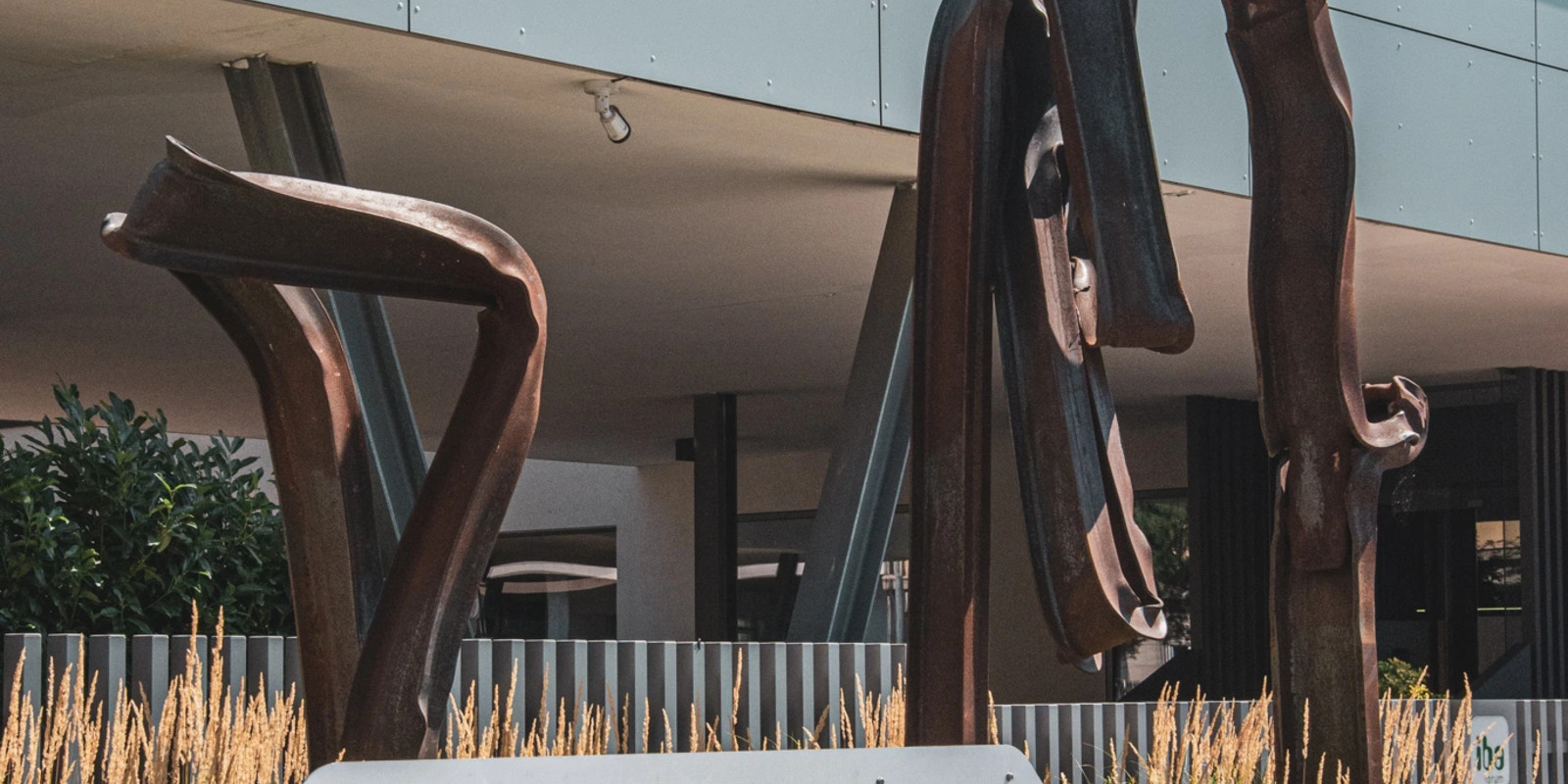
In front of the iba Forum, three rust-colored steel beams rise into the air, bent and twisted. Behind this artwork, however, lies a story that is closely connected to the role of the global player based in Fürth.
The production of steel beams is a highly complex process. A glowing steel billet, typically heated to temperatures between 720 and 1,260 degrees Celsius, is formed in multiple passes through interconnected rolling stands under enormous forces and rotational speeds. Similar to rolling out dough, the cross-section decreases while the material elongates, creating a continuous material flow. Since the amount of material fed into the rolling stands must precisely match the amount exiting them, this stage is particularly critical. If the process is not perfectly coordinated, the steel can leave its intended path and bend uncontrollably. This creates what are known in the industry as “cobble failures.” The fact that the resulting material can no longer be used is often the smallest problem. In rolling mills, cobbles can cause severe damage and frequently require hours of labor-intensive cutting and removal work. What such a failure can look like is demonstrated by the three distorted wide-flange beams in front of the iba Forum at Gebhardtstraße 10 in Fürth.
“They are a perfect way to explain why iba exists in the first place. Without high-resolution and continuous acquisition of all process variables, many modern manufacturing processes would be unable to meet today’s requirements in terms of quality and productivity,” says Dr. Ulrich Lettau, CEO of iba AG. As a specialist in the acquisition and analysis of measurement and process data, iba AG helps steel producers prevent exactly these types of cobble failures.
For decades, iba products have been used across various industries and in electrical power engineering to identify and eliminate faults, thereby improving processes and product quality.
Art or Scrap? In This Case, Both.
Wide-flange beams—commonly referred to as “I-beams”—are typically used in structural applications such as building or bridge supports. “iba helps ensure that the product comes out exactly as intended. And if something goes wrong, faults can be analyzed, identified in advance the next time, and ultimately prevented,” explains Lettau. The distorted beams in front of the iba Forum were provided to the company by a customer.
“Something went wrong during production, and through good contacts we were able to obtain these scrap pieces. We then turned them into a kind of monument and installed this artwork at the entrance to our company building,” says Lettau. Visitors can see what properly manufactured I-beams look like just a few meters behind the sculpture: the finger-shaped structure of the iba office building at Gebhardtstraße 10 is supported by steel beams that were rolled correctly and meet the required strength specifications.
