How FEST Makes Process Data Usable for Operations, Analysis and Maintenance
Based on the iba system, FEST has developed a data architecture that covers the entire process.
Learn more FEST Group
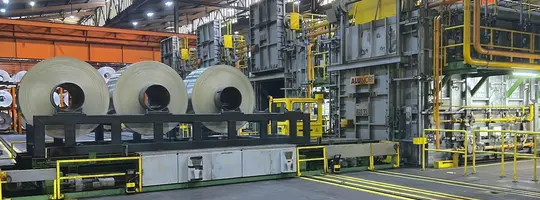
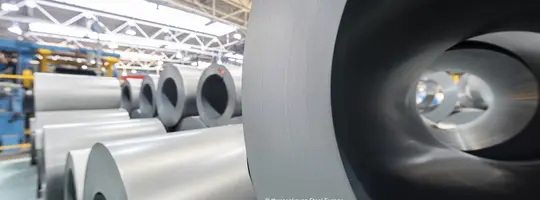
In the production of aluminum coils, proper strapping is essential to ensure safe handling and transport. Missing or improperly fastened straps pose a significant safety risk, especially in high-throughput finishing lines where manual checks are prone to human error.

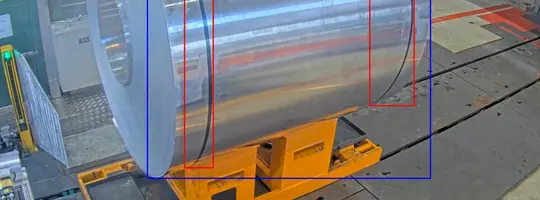
The objective of the project was to automatically detect both the number of coils and the number of straps using existing camera infrastructure, while ensuring seamless integration into the plant’s process data environment. The solution was not intended as a safety-certified system, but rather as a tool to improve process reliability and provide operators with valuable insights in real time. However, coil strap detection under real-world conditions presented multiple difficulties: coils differ in size, surfaces can be shiny or matte, and reflections and varying lighting conditions made traditional image processing unreliable. The fixed camera perspective further limited options for optimized image capture.
A deep learning approach with YOLOv8, a fast and lightweight object detection framework, offered the flexibility needed to handle visual variations and improve detection accuracy over time by simply adding more training images. Unlike static filter-based methods, AI models can be retrained and optimized continuously with minimal effort. An initial dataset of coil and strap images was manually annotated with bounding boxes. To account for real-world variability, the dataset was augmented by altering brightness, contrast, and sharpness and by simulating blur and noise. Three separate YOLOv8 models were trained in successive stages. The trained model was then integrated into ibaVision via a Python-based interface. The solution runs on the customer’s existing virtual machine without requiring GPU hardware. For every detected coil, ibaVision logs both the original camera image and the processed detection result into ibaCapture, while the number of coils and straps is recorded in ibaPDA for further process analysis.
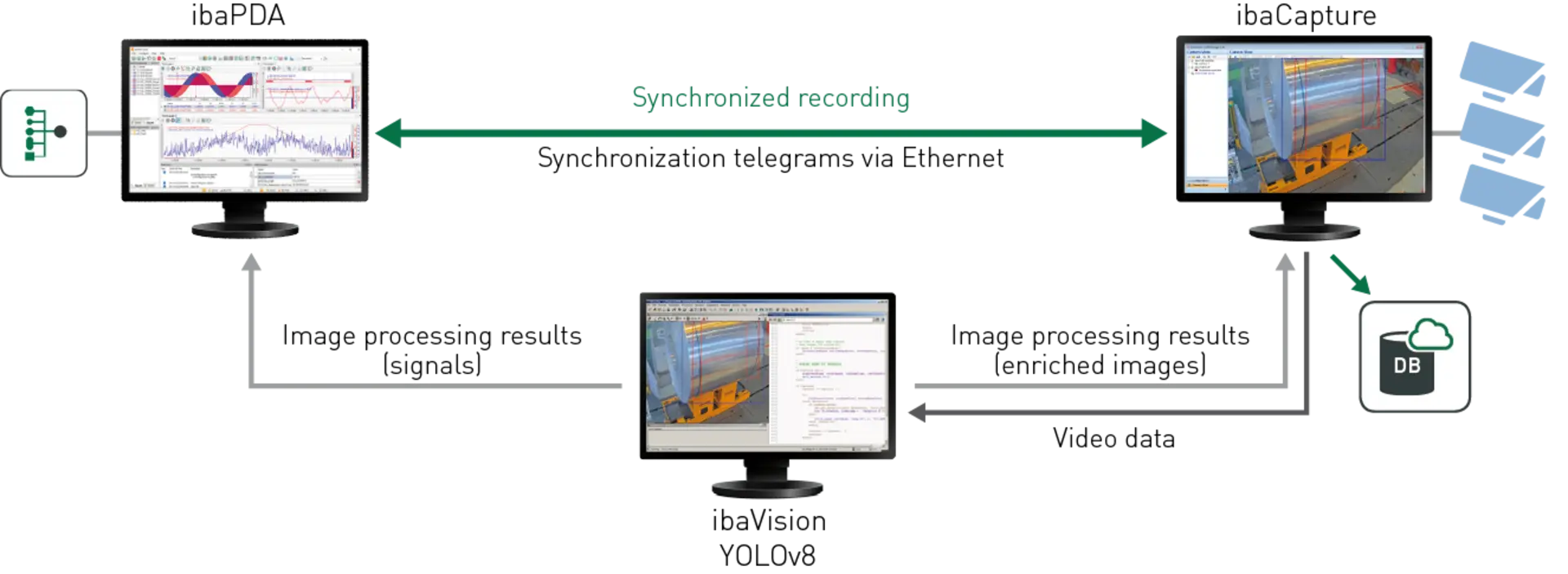
By combining YOLOv8’s AI-based detection with ibaVision’s powerful visualization and logging capabilities, the project successfully demonstrated how modern machine vision can increase process transparency and reliability without requiring complex infrastructure or advanced AI expertise on the user side.
With the combination of ibaVision, ibaCapture, and ibaPDA, we created a practical AI-based solution that fits seamlessly into the customer’s existing environment. The detection model, running within ibaVision, allows us to reliably count coils and straps, while ibaPDA logs the results and ibaCapture stores the corresponding images.
Artuur Krekels
Application & Consulting Engineer, iba Benelux
The following functions of the iba system are used in this success story.
Read more inspiring success stories of our satisfied customers.
Conventional rule-based image processing quickly reaches its limits when dealing with reflections, varying surface properties, and changing lighting conditions. The use of deep learning models such as YOLOv8 enables robust object detection through training on realistically augmented datasets. With ibaVision, such models can be integrated into existing camera systems and continuously retrained. This ensures stable detection performance even under varying production conditions.
Efficient integration requires seamless connectivity to existing data and system landscapes without adding hardware complexity. ibaVision enables the integration of AI models via standardized interfaces, for example based on Python. Detected objects and results can be directly transferred to ibaPDA and linked with process data. This creates a consistent data foundation for further analysis.
Complete traceability requires storing both the original images and the derived analysis results. With ibaCapture, image data and object detection results can be archived in time synchronization. In combination with process data from ibaPDA, this creates a complete context for every detected event. This enables detailed traceability and subsequent root cause analysis.
Integrating machine vision results into process data systems enables direct correlation between visual events and machine states. ibaPDA captures extracted metrics, such as object counts or states, in real time. This data can then be analyzed in detail using ibaAnalyzer. As a result, correlations can be identified and optimization potential can be derived.
A structured training process begins with the annotation of real-world image data and is enhanced through targeted data augmentation to reflect production variability. Models such as YOLOv8 can be iteratively improved by continuously integrating new data into the training process. With ibaVision, trained models can be deployed into existing systems without the need for specialized hardware. This enables scalable deployment across multiple plants with minimal infrastructure effort.