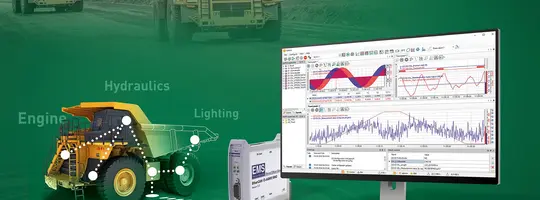
How FEST Makes Process Data Usable for Operations, Analysis and Maintenance
Based on the iba system, FEST has developed a data architecture that covers the entire process.
Learn more FEST Group
Edge analytics applications allow you to monitor processes locally in real time based on process data. The locally acquired process data can be autonomously processed directly where it is generated. A configurable alarming or output to control systems enable immediate reactions to deviations. Results and characteristic values can easily and securely be integrated in cloud infrastructures subsequently.

The iba system provides a very comprehensive process connectivity, which makes it possible to acquire process data over the entire production process.
All data is centrally available in one system time synchronously and in high-resolution: cyclical process data, controller data, sensor data, machine data and highly cyclical vibration and energy data. In addition, material and production data which provide additional information can also be integrated and read directly from databases.
With ibaPDA-PLC-Xplorer, for example, data from different controllers from different manufacturers can be acquired very easily. In addition to coupling digital and analog I/O data, data can be acquired from different field and drive buses as well as via Ethernet protocols or system connections.

Acquire data on the edge device and process it autonomously and automatically
Edge devices from iba record data as high-resolution raw data in a well structured way provided with a time stamp. The data can be stored locally and analyzed online on the device. Results immediately lead to outputs or alarms and are published as characteristic values (KPIs) to be used in superordinate systems, such as a cloud infrastructure, for global long term analysis.
The iba modular system with its different technology modules is ideally suited for the use as an edge device. The technology module ibaCMU-S is designed for classic condition monitoring applications. ibaPQU-S is used as a power quality unit to monitor the grid quality and realize all of the measurement tasks relevant for this purpose. The system measures grid-synchronously raw values, such as current and voltage, and internally calculates characteristic values according to EN 50160.
ibaDAQ provides an integrated ibaPDA system and can acquire data as a standalone device. The product ibaInSpectra can be used to realize vibration analyses and monitoring. The associated frequency analyses can be freely configured and carried out in real time. The product ibaInCycle can be used to monitor and analyze cyclical or rotating processes online.
The processor module ibaM-DAQ is part of the new system ibaMAQS. Due to the integrated ibaPDA system, the module is perfectly suitable for stand-alone data acquisition. The ibaNet-E protocol ensures very fast, deterministic transmission of process data.
The measurement data is processed on the edge device without the previous transmission into superordinate systems. Anyhow it would not be easily possible due to the data volume, the available band width, the latency and reliability, the interactions and safety precautions between the OT and IT network in general.
Results and characteristic values are analyzed and monitored online. Anomalies or limit violations are detected immediately. This is the only way an immediate response is possible, such as an alarming, notification by e-mail or an output to the controller. Process and quality data can thus be monitored directly in real time in the plant and not only subsequently in a separate analysis system.
In addition to time-based and time-synchronous acquisition of different process data, data can also be acquired in a triggered manner, for example for a certain production process. This is the best way to compare different workpieces with each other within a production process. Of course, characteristic values can also be calculated and monitored online synchronously to the process, i.e. after the production of a product.
The characteristic values calculated on the edge device can be output to superordinate systems for long term analysis. The big advantage of the iba system is that a drill down to the raw data is possible at any time in order to perform detailed analyses later, for example for a root cause analysis.
iba edge devices offer efficient solutions for digitalizing processes, plants and machines. Thanks to their modularity and scalability, edge devices are ideally suited for retrofitting in brownfield projects and existing plants and machines.
ibaDaVIS is a web-based analysis tool for visualization and analysis that can be used to create individual dashboards with different graphic elements to analyze the long-term behavior of the monitored processes and product quality. Interactive and flexible filter options allow you to analyze characteristic values calculated on the edge device for any questions.


Based on the high-frequency acquisition of raw data, the iba applications enable application-specific compression of data resulting in an automatic KPI calculation online on the edge device. Depending on the application, these characteristic values can be checked directly on the edge device for exceeding or falling below the limit values.


The following functions of the iba system are used in this application.
These leading companies already rely on the iba system.


Read the inspiring success stories of our satisfied customers.
Successful applications and real solutions with the iba system.
Edge analytics enables local processing of high-resolution process data directly in the edge device, allowing time-critical decisions without relying on centralized IT systems. With ibaPDA running on devices such as ibaDAQ or ibaMAQS, raw data is synchronously acquired, time-stamped, and analyzed immediately. Outputs such as KPIs or alarms can be generated in real time or transferred to IT systems and cloud platforms via interfaces like OPC UA, MQTT, or other industrial connectivity standards. This creates a clear separation between local real-time control and higher-level long-term analytics.
KPIs generated by edge analytics are selectively reduced and transmitted in a process-synchronous way to higher-level IT or cloud systems to minimize bandwidth usage and latency. Using ibaDaVIS or standardized interfaces, this data can be integrated into platforms such as SQL databases, SAP HANA, or cloud environments. At the same time, high-resolution raw data remains available locally in the edge device and can be accessed at any time via drill-down for detailed analysis. This creates a continuous data chain from the machine level to the cloud.
Local real-time processing significantly reduces latency and enables immediate responses to process deviations directly on the shop floor. With edge devices such as ibaDAQ or ibaMAQS, KPIs are calculated instantly and can be used for alarms or control actions without delay. At the same time, only relevant data is transferred to central systems, reducing network load and improving scalability. The combination of local analytics and centralized long-term storage provides an optimal balance between speed and analytical depth.
Edge analytics systems can be integrated modularly into existing plants without requiring major changes to the existing automation infrastructure. With ibaPDA and compatible edge devices, both modern and legacy control systems can be connected via various industrial protocols. This enables consistent data acquisition and analysis even in heterogeneous brownfield environments. As a result, existing production facilities can be gradually digitized and modernized.
Edge analytics applications can be modularly adapted to different process requirements and configured without deep changes to the system architecture. With ibaPDA and edge devices such as ibaDAQ or ibaMAQS, signal processing, KPI calculations, and alarm conditions can be defined flexibly through configuration instead of programming. Dedicated applications like ibaInSpectra for vibration analysis or ibaInCycle for cyclic processes extend functionality in a targeted way. This ensures scalability and enables gradual expansion even in existing industrial plants.