How FEST Makes Process Data Usable for Operations, Analysis and Maintenance
Based on the iba system, FEST has developed a data architecture that covers the entire process.
Learn more FEST Group
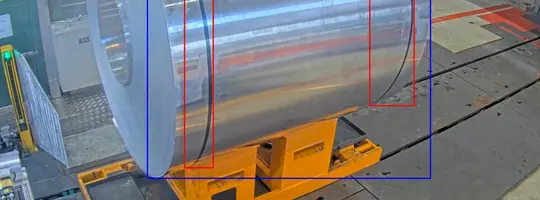
Usually, the operator does not have a free view on all components and aggregates from the control panel of a rolling mill. This is why camera systems are used in the field of process monitoring. Thus, disturbances in the process can be identified from the control panel and appropriate countermeasures can be taken.

For preventing disturbances in the process that have occurred once and should be prevented in the future, the root causes of these disturbances have to be identified. Recording the camera signals simultaneously to the process signals is a proven method for identifying these root causes. The project comprised the installation of ibaCapture and ibaPDA in a wire rod mill.

ibaPDA and ibaCapture record process and video signals time synchronously. For this purpose, ibaCapture sends synchronization signals to ibaPDA that are recorded simultaneously to the measurement data. In addition to the common analog and IP cameras, GigE cameras with a frame rate of up to 300 fps were used for acquiring the rapid processes in a wire rod mill. This is the foundation for a comprehensive online and offline analysis of the process behavior.
Download the demo of ibaPDA and ibaAnalyzer and start optimizing your processes today. Try it free of charge for 30 days!
Request a ibaPDA-Demo License
Recording video and process data in a synchronized way allows comprehensive root cause analyses when your process doesn’t work as intended.
Daniel Gauss
Product Manager, iba AG
Camera and process signals can be displayed online with ibaPDA and ibaQPanel.
In addition, process signals can be used for controlling the camera display. Using the scenario player, e.g. functions like the automatic and process controlled selecting the interesting camera or displaying critical process sections in slow motion can be implemented.
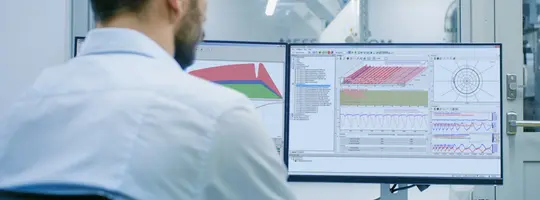
With the analyzing tool ibaAnalyzer, process and video images can be analyzed together. A recorded video sequence can be replayed in variable speeds. A marker moves time-synchronously over the displayed measurement signals. When analyzing interactively, the corresponding video image is displayed for the selected marker position.

The following functions of the iba system are used in this application.
These leading companies already rely on the iba system.


Read the inspiring success stories of our satisfied customers.
Successful applications and real solutions with the iba system.
Time-synchronized camera monitoring enables direct correlation of visual events with process signals and is therefore highly suitable for root cause analysis in complex rolling processes. With ibaCapture, video data is recorded in parallel with measurement data from ibaPDA and precisely time-aligned via synchronization signals. This allows disturbances observed in the video to be clearly linked to process states. It significantly improves root cause analysis and reduces the time required for fault identification.
Process and video data are captured time-synchronously through the combination of ibaCapture and ibaPDA, with synchronization signals ensuring precise temporal alignment. The data is stored jointly and is available for both online visualization and offline analysis in ibaAnalyzer. There, measurement curves and video sequences can be displayed in parallel and correlated. This creates a consistent analysis basis for process understanding and fault investigation.
The combination provides significantly improved transparency of hard-to-access process areas and critical equipment. While cameras deliver visual information, ibaPDA complements this with high-resolution process data such as speed, forces, or temperature profiles. By synchronizing both data sources, the causes of process disturbances can be precisely identified. This leads to faster response times and sustainably improved process stability.
Time-synchronized video analysis enables precise reconstruction of process sequences and visual events after the fact. With ibaAnalyzer, video sequences can be synchronized frame-accurately with measurement signals and navigated using markers. This allows critical process phases to be analyzed in detail and compared with corresponding sensor values. It significantly improves diagnostic accuracy and reduces ambiguity in interpretation.
Real-time camera monitoring enables immediate detection of process deviations and supports operators in responding quickly to disturbances. With ibaCapture and ibaQPanel, live images can be visualized together with process data and displayed in a process-controlled manner. Features such as automatic image switching or slow-motion analysis help better understand critical situations. This significantly improves responsiveness during ongoing operations.