How FEST Makes Process Data Usable for Operations, Analysis and Maintenance
Based on the iba system, FEST has developed a data architecture that covers the entire process.
Learn more FEST Group
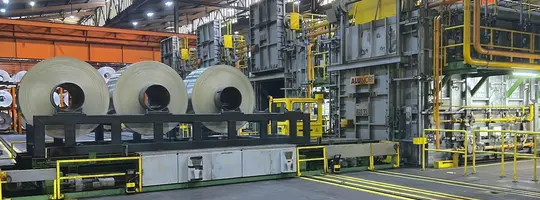
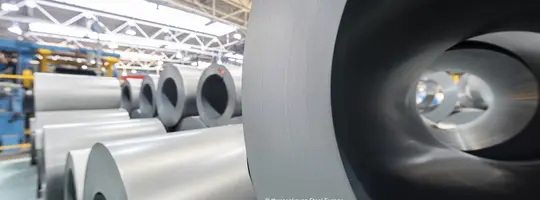
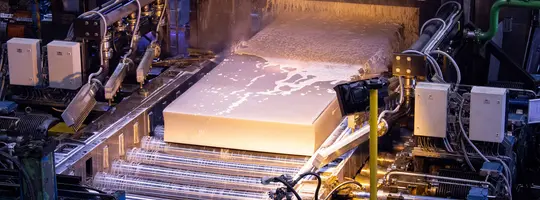
Alunorf is the largest aluminum rolling and smelting plant in the world. Around 1.5 million tons of rolled aluminum strip are shipped from the plant every year. In cooperation with iba AG, Alunorf successfully implemented automated quality data determination and processing on each of the two hot rolling lines in 2017 and 2019.
For hot rolling of aluminum, it is imperative to determine comprehensive product-related quality data. This data must be prepared in such a way that the quality can be evaluated on a strip-related and length-based basis.
Quality data must be made available online to the machine operators in order to always provide them with a comprehensive view of the quality-relevant data of the currently rolled strip.
For this reason, the two basic functions TEAS (Thickness Evaluation and Analysis System) and PEAS (Profile Evaluation and Analysis System) were implemented with the iba System.
Additionally, it must be ensured that the required key values are stored in the customer’s downstream quality systems so that this data can be analyzed and archived in the long term.
The entire processing chain must be reliable and automated.

The basis of the system is the fast process data acquisition (ibaPDA), in which data from various controllers, from measuring devices and from sensors are recorded time-synchronously. In addition, process-describing information such as product number, alloy and roll identifiers are also recorded.
ibaPDA runs initial quality and FFT calculations online, e.g. for the strip thickness quality and the effect of roll eccentricities on the strip thickness. The results are visualized on different clients product-related using ibaQPanel and thus made available to the machine operators.
The strip-related DAT files are the basis for the automated data processing. In ibaAnalyzer, the corresponding algorithms and parameters are mapped to calculate the required data results from high-resolution input data. In this process, time-related signals are converted into length-related signals.
The calculation of the data results and the transfer to the customer’s downstream systems is controlled automatically by ibaDatCoordinator. Potential network failures between the systems can also be compensated by ibaDatCoordinator.

The acquisition and analysis of strip-related measurement data enables comprehensive documentation and evaluation of product quality, both in real time and in a historical context. Prior-day quality scoring is performed on a daily basis and in an automated manner.
Uwe Gorzny
Process Engineer, Aluminium Norf GmbH

Download the demo of ibaPDA and ibaAnalyzer and start optimizing your processes today. Try it free of charge for 30 days!
Request a ibaPDA-Demo LicenseThe following functions of the iba system are used in this success story.
Read more inspiring success stories of our satisfied customers.
End-to-end quality data acquisition requires time-synchronous capture of all relevant process and product data across the entire rolling process. With ibaPDA, signals from control systems, measurement devices, and sensors are centrally acquired and linked with product-related information such as alloy or product ID. Based on this, quality KPIs can be continuously calculated. This creates a consistent and complete data foundation for quality evaluation.
Accurate quality evaluation requires converting time-based measurement data into length-based signals. In ibaAnalyzer, dedicated algorithms and parameters are used to transform high-resolution input data accordingly. Functions such as TEAS and PEAS enable detailed evaluation of strip thickness and profile across the entire strip length. This allows precise localization of quality-relevant deviations.
Effective process control requires immediate availability of quality data during production. With ibaPDA, relevant KPIs are calculated online and visualized via ibaQPanel. The visualization is product-specific and enables rapid assessment of the current rolling process. This allows operators to respond immediately to deviations.
Reliable data processing requires an automated and robust system architecture. With ibaDatCoordinator, the calculation of quality KPIs and their transfer to downstream systems are centrally managed and automized. Consistent data transmission is ensured even in the event of temporary network interruptions. This guarantees that data is always fully available for further analysis and archiving.
The combination of real-time processing and long-term storage enables comprehensive quality analysis. With ibaPDA, data is continuously acquired and processed, while strip-based datasets serve as the foundation for further analysis. Historical evaluations, such as daily quality assessments, can be performed automatically. This creates a sustainable basis for quality optimization and process improvement.